If you must leave home in a hurry, your pets must go too. Ready.gov, the CDC and the ASPCA all give the same core advice: prepare a kit, set up ID, and plan where you will go before a disaster.

Key takeaways
- Never leave pets behind. Ready.gov says that if officials ask you to evacuate, your pet should evacuate too.
- Pack food, water, medicine, records, ID and a carrier. The recommended supply ranges from several days to 2 weeks, depending on the source.
- Many shelters and hotels do not take pets, so know where you can go in advance.
- A microchip with up-to-date contact details is one of the best ways to be reunited with a lost pet (CDC).
What to put in the kit
Ready.gov recommends two kits: a larger one for sheltering at home and a light one for evacuating.
- Food and water: in waterproof containers, with bowls and a can opener. Sources differ: Ready.gov says “several days,” the ASPCA says 7 to 10 days of food and at least 7 days of bottled water per person and pet, and the CDC says 2 weeks of each per animal. Replace stored food and water about every two months, says the ASPCA.
- Medicine: about 2 weeks’ supply plus instructions (ASPCA and CDC). The CDC also lists a 1-month supply of flea, tick and heartworm preventives.
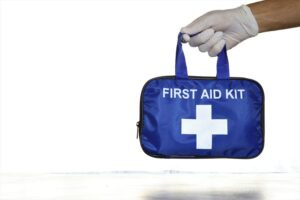
- First aid kit and guide. Ask your vet what to include.
- Leash, harness and a collar with ID tag, plus a backup set.
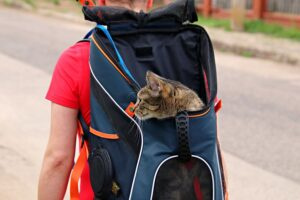
- A carrier for each pet, with bedding or a towel.
- Sanitation: litter and tray for cats, bags, paper towels, disinfectant.
- Comfort: familiar toys, treats or bedding.
- A recent photo of you with your pet, to show ownership.
Records and ID
- Copies of vaccination and medical records (rabies certificate, prescriptions and recent heartworm test for dogs, FeLV and FIV tests for cats), in a waterproof container and stored electronically.
- Registration or adoption papers, a description of your pet, and recent photos.
- Your microchip number and the chip company’s contact details. Register the chip and keep your phone numbers current.
- Collar tags showing the pet’s name and your phone number, and the contact details of a friend or relative outside your area.
Plan your evacuation
- Where to go: the ASPCA suggests checking your vet’s list of boarding kennels, local animal shelters, hotels outside the area that accept pets and friends or relatives. The CDC notes that many Red Cross evacuation centres do not accept pets, except service animals.
- A buddy: arrange a neighbour or friend who can check on or evacuate your pets if you cannot get home.
- Practise: leave carriers out with treats, and practise getting pets into them and into the car. Know where your cat hides.
- Keep the kit near the door, with leashes and carriers.
- After an emergency, keep pets on a leash or in a carrier, because familiar scents and landmarks may have changed.
Staying home
If you shelter at home, the CDC advises an interior room with few or no windows, away from toxic chemicals and plants, with small gaps closed off so cats cannot get stuck. Fill tubs and sinks with water before outages (ASPCA).
Other animals
The ASPCA gives separate advice for birds, reptiles, small animals and horses. For example, birds need a secure carrier and daily feeding. Ready.gov says large animals need ID, earlier evacuation and planned routes and destinations.
If you travel with pets, also see traveling abroad with a pet.
Frequently asked questions
How much water should I pack? The sources differ: several days, at least 7 days or 2 weeks. More is safer.
Do I need a microchip if my pet wears a tag? Tags can fall off. The ASPCA and CDC recommend a microchip too.
This article is general information based on guidance from Ready.gov, the CDC and the ASPCA. It is not personal medical, legal or financial advice. Talk to a qualified professional about your situation.
Information checked on November 17, 2026.
Sources
Ready.gov, “Prepare Your Pets for Disasters” (updated March 20, 2026); CDC, “Be Prepared: Pet Safety in Emergencies” and “Build a Pet Disaster Preparedness Kit” (April 9, 2024); ASPCA, “Disaster Preparedness.” Photos are stock images for illustration.