Key takeaways
- Use the pressure your vehicle’s maker recommends, found on the label on the driver’s door edge or post or in the owner’s manual, not the number printed on the tire itself.
- Check pressure when the tires are cold, meaning the car hasn’t been driven for at least three hours, and check the spare too.
- NHTSA says the tire pressure warning light (TPMS) means at least one tire is significantly underinflated. Check your tires as soon as possible.
- NHTSA recommends checking tires monthly with an accurate gauge, because the warning light isn’t a substitute for regular checks.
This article is general information based on NHTSA guidance, not a substitute for your vehicle’s owner’s manual or a mechanic’s advice.
Why tire pressure matters
NHTSA, the US vehicle safety regulator, says 511 people died in tire-related crashes in 2024. It says poor tire maintenance, such as not having enough air in your tires or failing to rotate them, “can lead to a flat tire, blowout, or the tread coming off your tire.”
NHTSA also points to savings: properly inflated tires can save as much as 11 cents per gallon on fuel and extend the average life of a tire by 4,700 miles. It says only 19 percent of consumers properly inflate their tires, so four out of five are wasting money.
How to check your tire pressure
NHTSA calls these steps “the most important part of maintaining your tires”:
- Find the recommended pressure. It’s on the Tire and Loading Information label on the driver’s side door edge or post, or in the owner’s manual. NHTSA stresses that the correct pressure is what the vehicle manufacturer lists, “NOT what is listed on the tire itself.”
- Check every tire, including the spare.
- If a tire is too high, slowly release air by gently pressing the valve stem with the edge of your gauge until you reach the correct pressure.
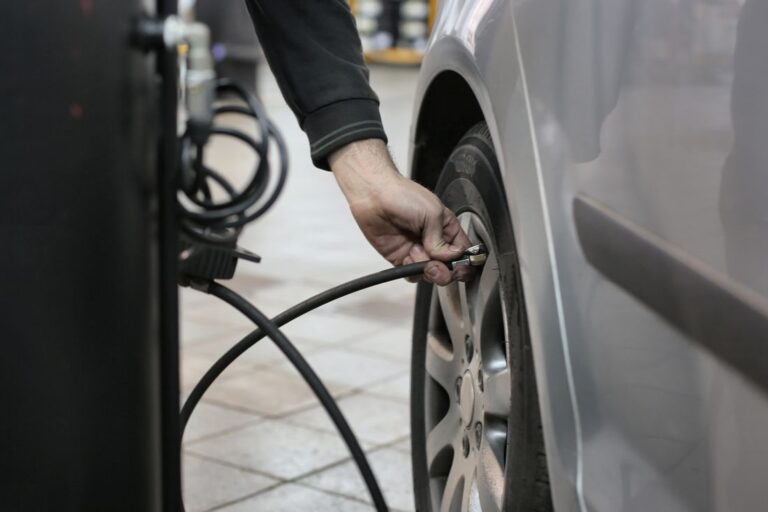
- If a tire is too low, note how many pounds are missing and add that much air at a service station.
- Check all the tires again to make sure they match, unless your car calls for different front and rear pressures.
Check when the tires are cold
The recommended pressure applies when the tire is cold, which NHTSA defines as not driven on for at least three hours. Warm tires read higher, so for an accurate reading measure them cold or allow for the extra pressure.
If you’ve been driving and think a tire is low, NHTSA says to fill it to the recommended cold pressure. The tire may still be slightly underinflated because of the warm air, but NHTSA says it is safer to drive on air that is slightly lower than the recommended cold pressure than on a significantly underinflated tire. Recheck when you can get a cold reading.
What the TPMS warning light means
Most newer cars have a tire pressure monitoring system, or TPMS. NHTSA says it uses sensors in the tires, or wheel-speed and other vehicle sensors, to warn you when pressure is below the acceptable level by lighting a symbol on your dashboard. Here’s what NHTSA says about each case:
- The light comes on and stays on. At least one tire is significantly underinflated. Inspect your tires and check the pressure as soon as possible. The symbol goes out after the tires are properly inflated.
- The light comes on, then goes off. On cold mornings it may light briefly, probably because pressure that is marginally low overnight rises as the tires warm up. NHTSA says to inspect your tires and check the pressure anyway. The light shouldn’t come on when tires are properly inflated.
- The light flashes for about 60 to 90 seconds, then stays on. That can mean the system isn’t working properly. This will repeat each time you start the car until it’s fixed, so NHTSA says to contact your dealer for an inspection. NHTSA says all TPMS on 2008 model year vehicles and later must detect and warn when the system is not functioning properly.
- “Wouldn’t I have noticed?” NHTSA says underinflated tires are hard to see. It recommends inspecting your tires monthly with an accurate gauge, and says “the TPMS is not intended to be a substitute for regular tire maintenance.”
Check the tread
NHTSA says tires should be replaced when the tread is worn down to 2/32 of an inch. Check the tread at least once a month when you check the pressure. Tires have built-in treadwear indicators, raised bars between the tread. When the tread is level with them, it’s time to replace the tires. You can also use the penny test: place a penny upside down in the tread with Lincoln’s head facing you. If you can see the top of Lincoln’s head, replace your tires.
Rotation and the spare
- Rotation: Check your owner’s manual for how often and in what pattern. If the vehicle manufacturer recommends it, NHTSA says to rotate tires every 5,000 to 8,000 miles, or sooner if uneven wear appears. For some vehicles rotation isn’t recommended, for example if front and rear tires are different sizes.
- The spare: Spare tires age because they’re seldom replaced. NHTSA recommends that a full-size spare not be used to replace worn tires, except in emergencies such as a flat.
If a tire blows out while you’re driving
NHTSA’s goal in a blowout is to keep the vehicle balanced and controllable. Don’t panic, and don’t slam the brakes or take your foot off the accelerator abruptly. Instead:
- Hold the steering wheel with both hands.
- Maintain your speed if you can do so safely.
- Gradually release the accelerator.
- Correct your steering as needed to stabilise the vehicle, looking and steering where you want to go.
- Once the vehicle is stable, keep slowing down and pull off the road when and where you judge it’s safe.
The steps are the same for a front or rear tire. A front blowout is felt more in the steering, and a rear one in the seat or body of the car.
For more on warning systems in newer cars, see our guide to driver assistance technology.
Frequently asked questions
Where do I find the right tire pressure? On the label on the driver’s door edge or post, or in the owner’s manual. Not on the tire.
When should I check my tires? NHTSA says monthly, with an accurate gauge, when the tires are cold.
Is it safe to drive with the TPMS light on? NHTSA says the light means at least one tire is significantly underinflated and to check your tires as soon as possible.
Can I rely on the warning light alone? No. NHTSA says it is not a substitute for regular tire checks.
Information checked on: October 31, 2026. Check your owner’s manual for your own vehicle.
Sources
- NHTSA, Tires (TireWise), nhtsa.gov